
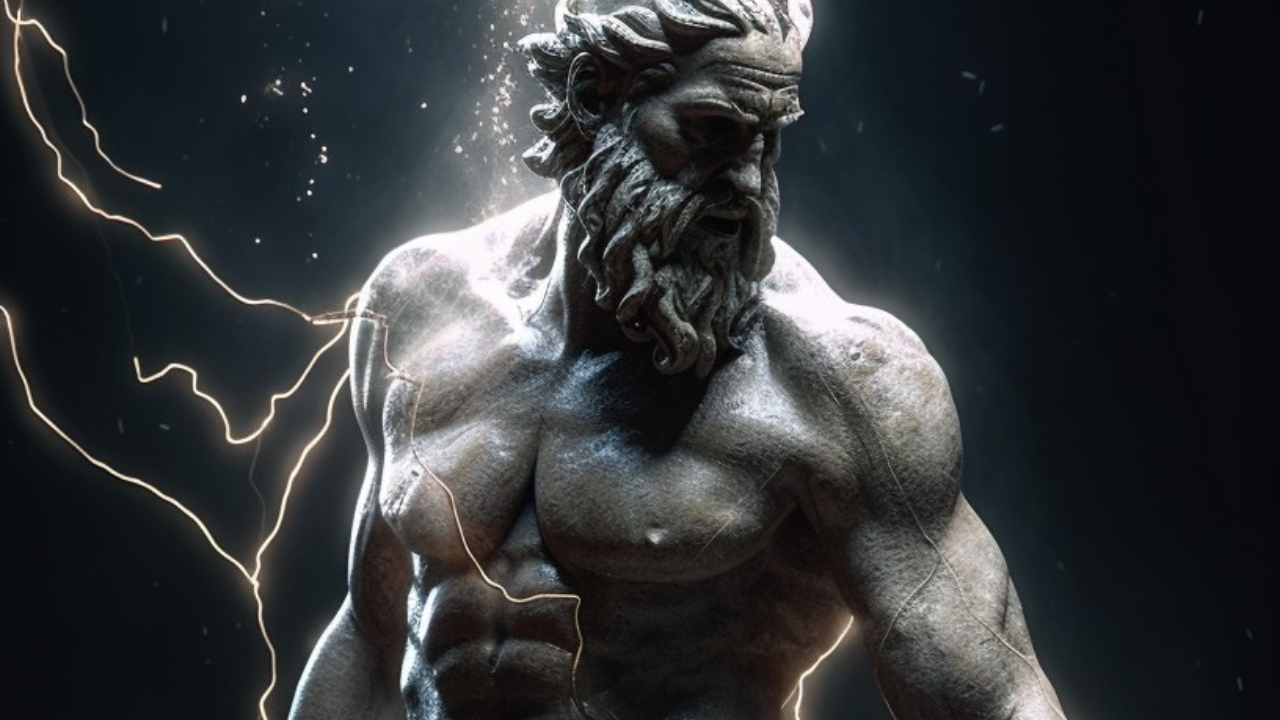

One of the most surprising things I discovered when I started engaging with the Hellenism community online was this:
A lot of people really hate Zeus.
And I don’t mean they mildly dislike him.
I mean they see him as abusive, controlling, promiscuous, patriarchal, misogynistic, and pretty much the embodiment of everything they’re trying to move away from in their spiritual practice.
At first, I was confused.
Because as a native priest of the Hellenic ethnic religion, my relationship with Zeus didn’t come from Tumblr posts, Percy Jackson discourse, or literal readings of myth.
My practice and training have always been rooted in Greece and Cyprus, where we have a very different relationship with the gods.
We don’t see them as fictional characters in stories.
We see them as living universal laws, divine functions, and sacred powers that hold the cosmos together.
And that distinction matters.
Because when you take the myths literally, Zeus can look like a terrible man.
But Zeus isn’t a man.
He isn’t a flawed human being sitting on a cloud, cheating on his wife and throwing thunderbolts when he doesn’t get his way.
That’s mythology.
Not theology.
Theological Zeus is the force of divine order.
He is the sky that holds everything.
He is justice, law, protection, sovereignty, hospitality, prophecy, and the intelligence that turns chaos into cosmos.
He doesn’t control the universe like a dictator.
He maintains order within it.
And that’s why, in July, we honor Zeus as the god of the month in the Living Hellenism wheel of the year.
This is the season after the Summer Solstice, when Apollo’s light has reached its peak and Zeus helps us take that revelation and bring structure to it.
It’s the moment when inspiration becomes order.
When light becomes direction.
When chaos becomes cosmos.
In this month’s episode of the Living Hellenism podcast, Elyse and I explore why so many modern practitioners struggle with Zeus, what the myths are actually trying to teach us, and how to understand his true essence beyond the literal stories.
We also talk about the Dioscuria festival, celebrating the divine twins Castor and Pollux, and what their myth teaches us about the relationship between our mortal and immortal selves.
This episode is for you if you’ve ever felt conflicted about Zeus, confused by the myths, or curious about how native Hellenic practitioners understand the gods beyond the stories.
Listen to Episode 3 of Living Hellenism now and discover Zeus beyond the myths.
If you’re ready to take your manifestation practice to the next level, be sure to get my book Ancient Manifestation Secrets, teaching you a brand-new method of manifesting with the energy field.
Are you ready for a new spiritual journey? Take this 2-minute quiz to find out what your next spiritual transformation will be about.
Recommended for you






Haven't found your life purpose yet?
Sign up below to download my FREE step-by-step guide to find and define your life purpose in a specific two-paragraph definition. You'll also receive a weekly email from me packed with intuitive guidance, spiritual processes, and exclusive trainings to support your journey.